
4 Spheres of Dominion
Advancing God’s Kingdom as a King-Priest After the Order of Melchizedek
For Christian business leaders, entrepreneurs, executives, investors, and marketplace professionals
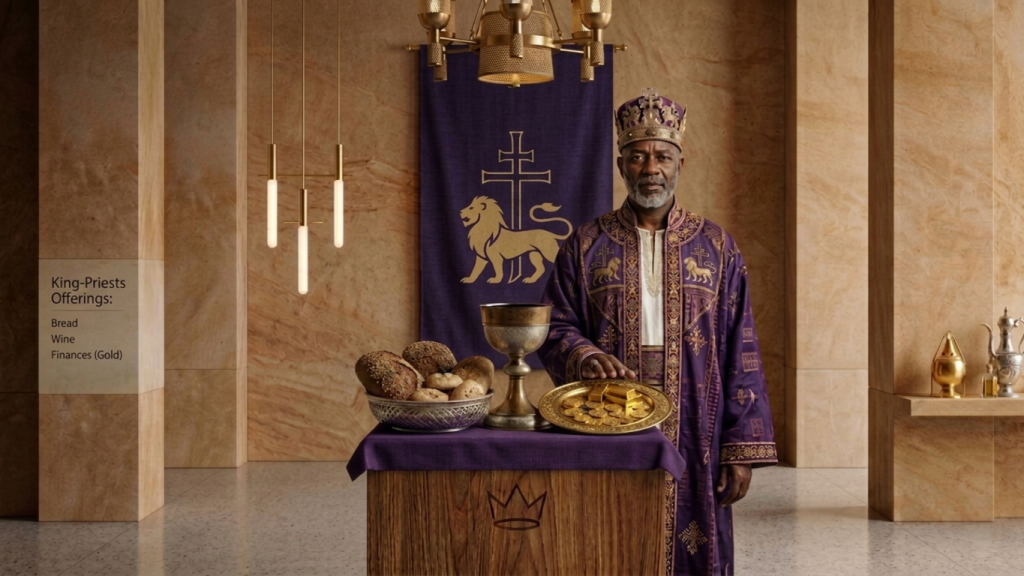
When Melchizedek stepped into Abraham’s story as “king of Salem” and “priest of God Most High” (Genesis 14:18), he embodied a rare union: royal authority and priestly devotion held together in one person. Israel would later separate those offices, but the prophetic thread ran forward until it found its fulfillment in Jesus, our “priest forever, in the order of Melchizedek” (Hebrews 7:17) — the King of kings who is also our great High Priest. Through union with Him, every believer is drawn into that same order: “a royal priesthood” (1 Peter 2:9) made to be “a kingdom and priests to serve his God” (Revelation 1:6).
This is where dominion must be rightly understood. From the beginning, God gave humanity dominion — but the mandate was to “work” and “take care of” the garden (Genesis 2:15), to cultivate and protect, not to dominate or exploit. Biblical dominion is God-given stewardship exercised with humility, righteousness, justice, and service. It looks less like conquest and more like a gardener tending what belongs to Another. “The earth is the Lord’s, and everything in it” (Psalm 24:1); we are trustees, not owners. So when we speak of “taking territory for the Kingdom,” we do not mean seizing power over people. We mean faithfully expanding God’s influence by embodying His righteousness, peace, truth, and love wherever He has placed us.
Christian business leaders are uniquely positioned for this. You touch resources, relationships, decisions, and culture every single day. Your calendar is your parish; your enterprise is your field of stewardship. Business is not merely a source of income but a divine assignment through which you partner with God to bring transformation to individuals, organizations, communities, and nations. Here are four spheres in which that dominion is expressed.
1. Economic Rule — Stewarding Resources for Kingdom Purposes
God entrusts His people with influence over economic resources — not so they can accumulate status, but so they can serve others and advance His purposes. It is God who “gives you the ability to produce wealth,” and He does so to confirm His covenant (Deuteronomy 8:18). In the parable of the talents, the master commends not the one who hoarded but the ones who stewarded and multiplied what was entrusted, saying, “Well done, good and faithful servant” (Matthew 25:21). Kingdom economics joins wealth creation with integrity, innovation with ethics, and profit with generosity. The goal is not less excellence but more — “Whatever you do, work at it with all your heart, as working for the Lord” (Colossians 3:23) — because excellent work that genuinely serves people is itself a form of love.
In the marketplace: Economic influence becomes a platform for God’s mission when you create real value rather than extract it, price and report honestly, pay people fairly, and build margin so you can be generous on purpose. Consider the entrepreneur who caps his own compensation to fund employee development, or the investor who directs capital toward businesses that dignify the poor. Wealth handled this way preaches: it shows a watching world that prosperity and righteousness were never meant to be enemies.
Actionable takeaway: Audit one area of your finances this week — pricing, pay, or giving — and align it more closely with Kingdom stewardship rather than mere profit maximization.
2. Marketplace Intercession — Bringing God’s Presence into Business
A King-Priest ministers in two directions at once — before God on behalf of people, and among people on behalf of God. This is the priestly half of the calling, and it turns an ordinary business into a place where heaven is welcomed. Paul urges that “petitions, prayers, intercession and thanksgiving be made for all people” (1 Timothy 2:1), and Jeremiah told the exiles to “seek the peace and prosperity of the city… pray to the Lord for it” (Jeremiah 29:7). Leaders who lack wisdom are invited to “ask God, who gives generously” (James 1:5). Marketplace intercession means seeking God’s wisdom before decisions, leading by the Spirit, and carrying discernment and spiritual sensitivity into rooms where others bring only spreadsheets.
In the marketplace: You carry God’s presence into every meeting, negotiation, and decision — so lead accordingly. Pray for your employees, customers, and suppliers by name. Pause before a major decision to ask the Spirit for guidance rather than reacting from pressure. Become the person in the building who dispenses peace, encouragement, and hope instead of anxiety. When a team senses that their leader has already sought God, it changes the temperature of the whole room.
Actionable takeaway: Adopt one prayer rhythm this week — for example, praying briefly over your calendar each morning and lifting up one employee or client by name each day.
3. Generational Blessing — Building a Lasting Kingdom Legacy
Kingdom influence is measured not only by what you build but by what outlives you. “A good person leaves an inheritance for their children’s children” (Proverbs 13:22), and Paul’s discipleship model was explicitly generational: “the things you have heard me say… entrust to reliable people who will also be qualified to teach others” (2 Timothy 2:2). True success reaches four generations deep in a single verse. That means the leader’s task is not merely to perform but to reproduce — to disciple future leaders, mentor employees, build healthy cultures, and design businesses that can flourish after the founder is gone. The goal is to leave a spiritual inheritance, not only a financial one.
In the marketplace: Intentional legacy-building looks like an owner who documents values and trains successors long before retirement, a manager who treats mentoring as core work rather than a distraction, and a family that stewards wealth with wisdom across generations instead of letting it corrode character. Ask not only “What can I achieve?” but “Whom am I raising up, and what will remain when I am no longer in the room?”
Actionable takeaway: Choose one person to intentionally mentor this quarter, and begin passing on not just skills but the values and faith that shape how you lead.
4. Cultural Transformation — Influencing Society Through Kingdom Values
Jesus called His followers “the salt of the earth” and “the light of the world,” adding, “let your light shine before others, that they may see your good deeds and glorify your Father” (Matthew 5:13–16). Salt preserves and light reveals — both work quietly, from within. Business leaders are among the most influential culture-shapers in any society, and every workplace becomes an opportunity to demonstrate God’s Kingdom. When leaders act with integrity, do justice, “love mercy and… walk humbly” (Micah 6:8), and create environments where people can genuinely thrive, they contribute to the renewal of society itself. This is dominion as cultural renewal — never coercion, always the compelling witness of a better way.
In the marketplace: A business shapes culture when it practices servant leadership, makes ethical decisions even at a cost, innovates for human flourishing, and treats employees as image-bearers rather than resources. Think of a company that refuses exploitative practices its competitors accept, or one that rebuilds trust in a cynical industry simply by keeping its word. Communities notice. Over time, such businesses raise the standard for everyone — and point beyond themselves to the God whose character they reflect.
Actionable takeaway: Identify one practice in your industry that falls short of God’s justice or compassion, and commit to modeling a better, Kingdom-shaped alternative.
Conclusion: One Calling, Four Spheres
Economic rule, marketplace intercession, generational blessing, and cultural transformation are not four jobs; they are four expressions of one calling. Together they describe a King-Priest who stewards resources faithfully, carries God’s presence into the everyday, builds a legacy that outlasts them, and shapes culture by reflecting Christ. None of it is about domination over people. All of it is about faithfully expanding God’s influence — His righteousness, justice, peace, truth, and love — in the places He has entrusted to you.
So refuse the small story that says your business is only a way to make a living. It is a field of dominion and a divine assignment. Every decision, relationship, opportunity, and challenge is a chance to partner with God and advance His Kingdom. The world does not need more Christians who merely survive in the marketplace; it needs King-Priests who steward it, intercede over it, build for its future, and transform it from the inside out. Take up your calling on purpose. Bring the Kingdom to work — and watch what God does through a leader who knows exactly who they are and Whom they serve.
Reflective Questions
Evaluate how you are currently walking in these four spheres of dominion, and identify one practical step of growth in each:
- Economic Rule — Am I stewarding wealth to serve God’s purposes and bless others, or to build my own status and security?
- Marketplace Intercession — Do I actually seek God and carry His presence into my decisions and relationships, or do I lead on autopilot?
- Generational Blessing — Whom am I discipling, and what spiritual and organizational inheritance will remain when I am gone?
- Cultural Transformation — Is my business raising the standard of righteousness, justice, and flourishing in my industry and community?
- Overall — Where is God inviting me to move from merely running a business to advancing His Kingdom through it?