The Identity Shift
Living and Leading as a King-Priest After the Order of Melchizedek
For Christian business leaders, entrepreneurs, and marketplace professionals
Before a single strategy is written, a market is entered, or a team is hired, something quieter has already determined the outcome: what you believe about who you are. Every leader operates from an identity, whether they have named it or not. The entrepreneur who secretly believes she is only as valuable as her last quarter will build differently than the leader who knows he is a son of God commissioned to carry heaven into the marketplace. As Dr. Dale Mast puts it, a life shift requires an identity shift. The new season God is preparing for His people does not begin with a new opportunity; it begins with a new understanding of who we are. Until we speak what He has spoken about us, we will not impact the earth with heaven.
1. Why Identity Matters
Identity is the answer your soul gives to the question, “Who am I?” — and that answer quietly governs everything else. Scripture treats identity as foundational rather than decorative. When God called Jeremiah, He did not begin with a task; He began with a truth about who Jeremiah already was: “Before I formed you in the womb I knew you, before you were born I set you apart” (Jeremiah 1:5). Jeremiah’s protest — “I am too young” — was not a scheduling problem but an identity problem. God’s response was not to argue about his qualifications but to correct his self-perception.
Practically, identity is the lens through which we interpret reality. It shapes our beliefs, and our beliefs shape our behavior, our decisions, our leadership, our relationships, and ultimately our purpose. Mast observes that “faith focuses on God and His ability; identity focuses on us and our ability. It’s easier to believe what God can do than to believe what He can do through us.” This is why identity, not effort, is so often the true bottleneck. A person can believe God is powerful and still forfeit their calling because they do not believe He wants to work through them.
False identities are costly precisely because they feel like humility or realism. The Israelites watched miracle after miracle deliver them from Egypt, yet “they couldn’t shift their identity from slaves to warriors.” The result was a generation that died in the wilderness between deliverance and destiny. Complaining, Mast notes, is often the telltale sign that an identity shift has not happened — it “reveals that we see our circumstances as greater than our identity.” For the marketplace leader, false identities show up as chronic striving, fear of exposure, comparison, and an inability to rest in a win. A slave mindset can operate a business, but it cannot advance a Kingdom.
2. The Biblical Foundation of the King-Priest
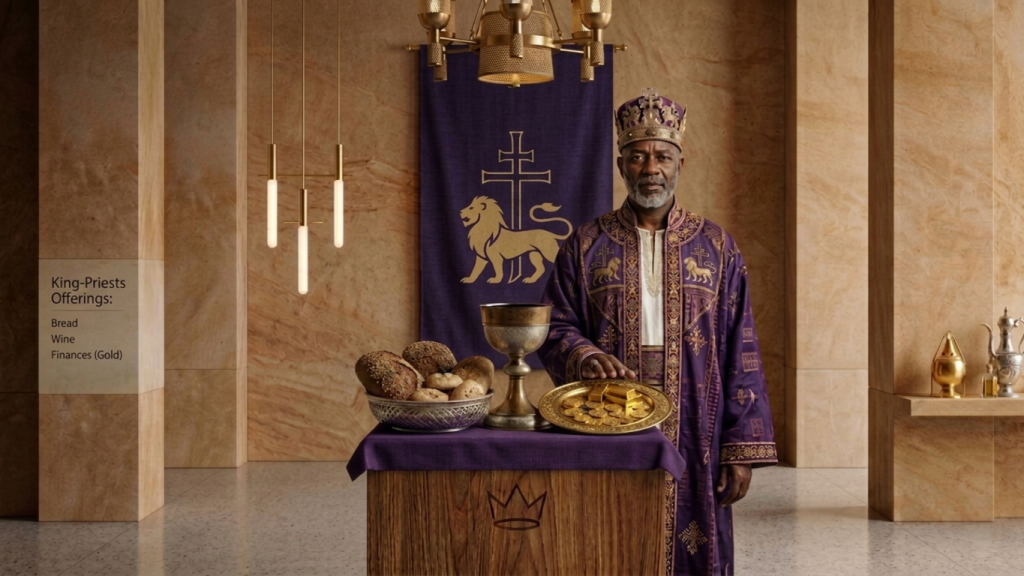
The phrase “King-Priest” is not a modern invention; it is rooted in one of the most mysterious figures in Scripture. Melchizedek appears briefly in Genesis 14:18–20, where he is introduced as “king of Salem” and “priest of God Most High.” He blesses Abram and receives a tithe. What makes him remarkable is the union of two offices that Israel would later keep strictly separate: kings came from Judah, priests from Levi, and no one held both. Melchizedek held both — authority and intimacy, government and worship, dominion and consecration — in a single person.
“The Lord has sworn and will not change his mind: ‘You are a priest forever, in the order of Melchizedek.’” — Psalm 110:4
Psalm 110, the most quoted psalm in the New Testament, prophesied a coming figure who would be both King at God’s right hand and Priest forever in Melchizedek’s order. The book of Hebrews reveals that figure to be Jesus. “You are a priest forever, in the order of Melchizedek” (Hebrews 5:6) — a priesthood established not by ancestry or law but “on the basis of the power of an indestructible life” (Hebrews 7:16). Jesus is the ultimate High Priest and the King of Kings, and He holds both offices permanently.
Here is the astonishing part for believers: we are not merely spectators of His priesthood; we are brought into it. “You are a chosen people, a royal priesthood, a holy nation, God’s special possession” (1 Peter 2:9). Christ “has made us to be a kingdom and priests to serve his God and Father” (Revelation 1:6; see also Revelation 5:10). Through union with Christ, the believer receives a Kingdom identity — King-Priest — that reaches into every arena of life, including business and the marketplace. You are not a saved individual who also happens to work; you are a King-Priest who has been assigned a domain to steward.
3. The Identity of a King-Priest
What does this dual identity actually contain? Nine characteristics mark those who live from it:
- Sonship and covenant identity. Everything begins here. Jesus operated from His “primary identity as the Son of God, and it empowered Him to shift things on the earth” (Mast). We are adopted heirs, not hired hands (Romans 8:15–17).
- Authority and Kingdom government. A king carries delegated authority to establish order. Believers are seated “with him in the heavenly realms” (Ephesians 2:6) to govern their sphere on Christ’s behalf.
- Intimacy with God. A priest lives before the face of God. Mast warns that identity “must be held in place by thoughts we receive from Father God” — sustained not in a moment of faith but in ongoing communion.
- Stewardship and responsibility. Kingship is trusteeship. “Whatever God establishes in us is directly connected to what we will do to help others” (Mast). Authority is given for service, not accumulation.
- Righteousness and holiness. Melchizedek means “king of righteousness,” and Salem means “peace” (Hebrews 7:2). A King-Priest carries both — right standing that produces right dealing.
- Servant leadership. The greatest King washed feet (John 13). Kingdom authority always descends to serve before it rises to rule.
- Wisdom and discernment. A priest distinguishes the holy from the common (Ezekiel 44:23). Marketplace King-Priests judge situations by the Spirit, not merely by the spreadsheet.
- Faith and obedience. “It pleases God when we respond in faith with action” (Mast). Identity is confirmed through obedient response, not passive belief.
- Representation of God’s Kingdom on earth. Ambassadors carry the authority of the one who sent them (2 Corinthians 5:20). The King-Priest makes an unseen Kingdom visible in a boardroom.
4. How a King-Priest Functions in the Marketplace
This identity is not meant for the sanctuary alone. David, Mast points out, “perceived that God had established him as king for the sake of Israel — not for the sake of his ministry.” In the same way, God establishes marketplace leaders for the sake of others. Here is what that looks like in practice:
- Leading with integrity and righteousness. The King-Priest keeps his word when it costs him (Psalm 15:4), refusing the double standards the market tolerates.
- Building businesses that honor God. The enterprise itself becomes an altar — its products, culture, and ethics designed to reflect the character of the King.
- Exercising Kingdom authority without domination. Authority is used to empower people, not to control them; to open doors, not to crush rivals.
- Creating wealth for Kingdom purposes. God “gives you the ability to produce wealth” to confirm His covenant (Deuteronomy 8:18). Profit becomes provision for a larger assignment.
- Serving employees, customers, and communities. The leader asks not only “What can this business extract?” but “Whom is this business called to bless?”
- Making Spirit-led decisions. Prayer and discernment shape hiring, timing, and strategy, so the calendar and the budget come under God’s counsel.
- Bringing justice, peace, and restoration. As king of righteousness and peace, the King-Priest fights corruption, pays fairly, and leaves environments healthier than he found them.
- Viewing business as ministry and worship. “Whatever you do, work at it with all your heart, as working for the Lord” (Colossians 3:23). The work itself becomes an offering.
5. Making the Identity Shift
If this identity is already true in Christ, why do so few live from it? Because competing identities offer counterfeit security. The most common traps are performance (“I am what I produce”), success (“I am my results”), fear (“I am what could go wrong”), status (“I am my title”), self-reliance (“I am what I can control”), and comparison (“I am how I measure against others”). Each promises identity but delivers anxiety, because it is anchored in circumstance rather than in sonship.
Transformation begins where Scripture says it always begins — in the mind. “Do not conform to the pattern of this world, but be transformed by the renewing of your mind” (Romans 12:2). Mast frames it plainly: “Until we think differently, nothing new will flow from our life. One new thought can elevate what we already know to a superior level.” The shift is not achieved by trying harder in an old identity; it is received by agreeing with God about a new one.
Practical steps to embrace the King-Priest identity daily:
- Declare what God says. “Our words create our identity” (Mast). Begin the day speaking Scripture over yourself before the market speaks its verdict.
- Shift your activity. “When we shift our activity, it affects our identity” (Mast). Take one obedient action that only a King-Priest would take — a Spirit-led decision, an act of generosity, a stand for integrity.
- Keep the priestly appointment. Guard daily time in God’s presence; identity is “held in place by thoughts we receive from Father God.”
- Refuse the complaint. Treat grumbling as an early warning that circumstances are looming larger than identity, and return to worship.
- Embrace the Goliaths. “It takes a Goliath to reveal a David” (Mast). Face the challenge only God can win, and let the victory reset your self-perception.
6. Conclusion: Perceive Who You Are
David “chose to take on Goliath because he believed that God would make him king someday. David’s vision of his future fueled his faith for his present battle” (Mast). That is the invitation before every Christian in the marketplace. You may have to live beyond your father’s opinion of your life, beyond the industry’s definition of success, beyond your own history of striving. Father God was dreaming of your purpose when He created you, and He has greater dreams for your work than you could imagine.
So stop seeing yourself as merely a business owner, a professional, or a founder. You are a King-Priest after the Order of Melchizedek — one who carries God’s presence into places most people never bring Him, who represents an unshakable Kingdom in the middle of a shaking economy, and who is positioned to transform culture through the ordinary faithfulness of your work. The world does not need more Christians who happen to be in business. It needs King-Priests who know exactly who they are. The life shift you long for is waiting on the other side of the identity shift. Speak what He has spoken. Then go and impact the earth with heaven.
Reflective Questions
Sit with these questions honestly, and let them surface whether you are leading from your true Kingdom identity:
- When you introduce yourself, what identity are you actually leading from — your role, your results, or your sonship?
- Where in your business are you operating with a slave mindset when God has called you to lead as a warrior and King-Priest?
- What has your complaining been revealing about where your circumstances feel bigger than your identity?
- If you truly believed God wanted to work His purposes through you, what decision would you make this week that you have been avoiding?
- Whom has God established you to serve and bless — and is your business currently arranged to do it?
- What is the “Goliath” you are being invited to face that could reveal the leader God says you already are?